Your AQA English Literature Paper 1 on May 13. How ready are you for Macbeth and Dr Jekyll & Mr Hyde?
REMEMBER to make links to relevant context and themes throughout your response. If you studied it, it MUST be in your essay.
Examine the exemplar response below. Look at: essay structure, clear introduction, PEA (Point. evidence, analysis), wide selection of quotes from the extract, exploration of the play as a whole etc.
EXAMINE THE EXEMPLAR RESPONSE BELOW
ALWAYS write an effective introductory paragraph. Examine the examples of effective intros below.
Your AQA English Literature Paper 1 on May 13. How ready are you for Macbeth and Dr Jekyll & Mr Hyde?
REMEMBER to make links to relevant context and themes throughout your response. If you studied it, it MUST be in your essay.
Examine the exemplar response below. Look at: essay structure, clear introduction, PEA (Point. evidence, analysis), wide selection of quotes from the extract, exploration of the play as a whole etc.
EXAMINE THE EXEMPLAR RESPONSE BELOW
ALWAYS write an effective introductory paragraph. Examine the examples of effective intros below.
Question 4 is nationally the weakest link for most students. It doesn’t have to be. Examine my resources and practise.
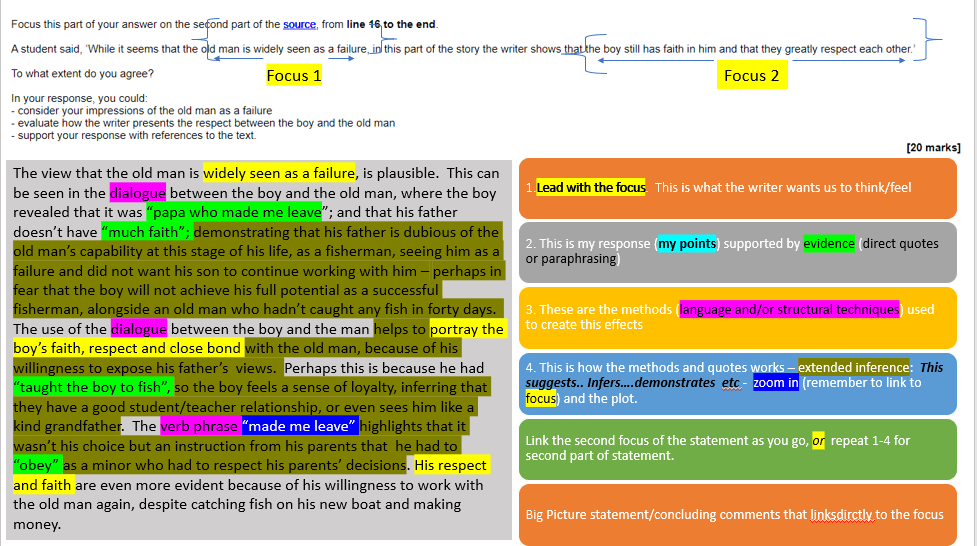
To start, identify the focus of the statement. Sometimes it can have 2 or more parts to it. Lead with the focus and make links consistently in every paragraph of your response.
2. Support your views with relevant textual details; direct quotes from the section the task tells you to, and/or paraphrase.
3. State themethods used (language and/or structural techniques)
4. Give extended inference of the effects of both the techniques and the language of the quotes.
Examine the example below that uses the November 2022 paper. This is not a full response. It simply models how to follow the 4 steps above to effectively respond to the task.
Remember, you know the structure of the questions. You’ve been practising them. Simply identify the questions you’re weakest at, (the bug-bears)and practise those. Examine exemplar responses alongside the exam marking criteria. All these can be found on your exam board website.
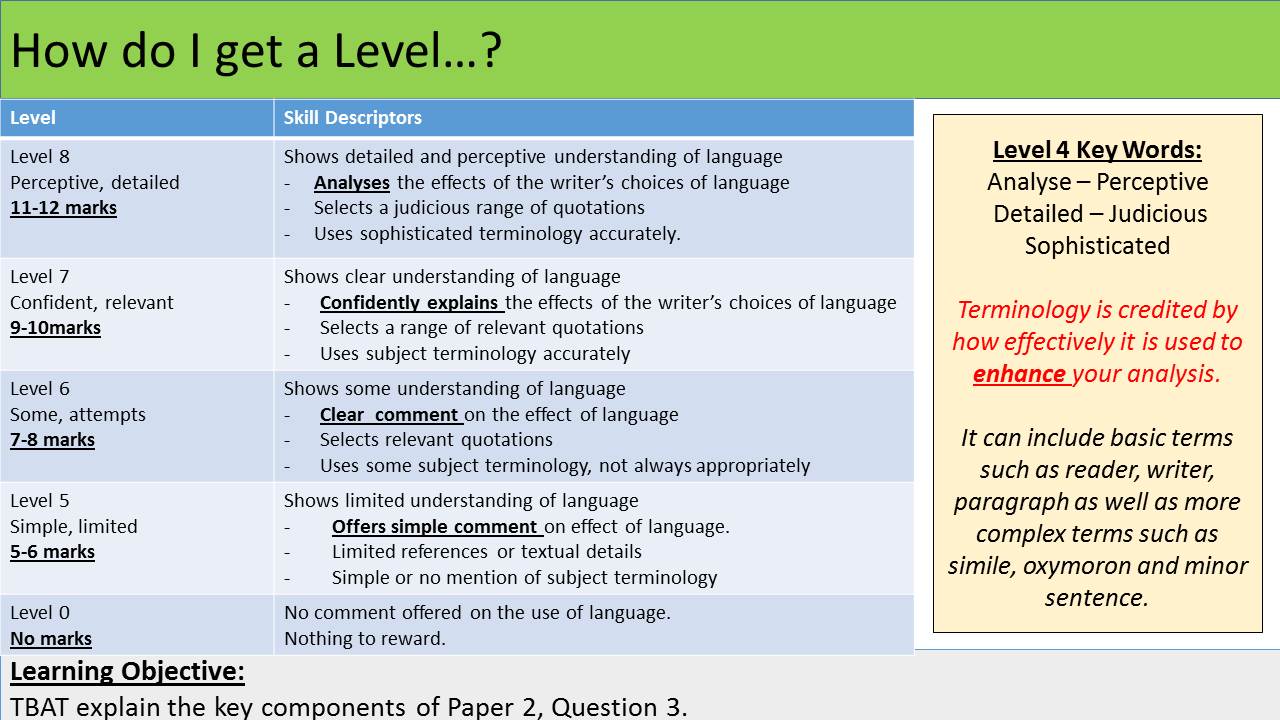
PAPER 1 QUESTION 3 –A WEAKNESS FOR MOST. Structure of a text is simply about how the plot develops from beginning, middle to end. THIS IS NOT ABOUT LANGUAGE TECHNIQUES.Structural techniques are: focus at the beginning, middle and end, plus other structural techniques such as: paragraph lengths, sentence types, choice of punctuation, flashbacks, flashforwards, tense, dialogue etc.
The above response was awarded full 8 marks with the notes below.
MORE GUIDANCE ON QUESTION 3
QUESTION 4 IS ALSO ANOTHER BUG-BEAR. THE PURPOSE OF THIS QUESTION IS WRITING TO ARGUE/PERSUADE: To what extent do you agree? You MUST find the words and phrases in the part of the text directed, that would support the views presented in the statement, but you can also present an opposing view (AO1). You cannot simply disagree. REMEMBER to explore the effects of language and/or structural techniques (AO2) used in the quotes you use.
The above responses are real GCSE marked responses. Response 7 was awarded 17 of the 20 marks. Response 6 below was awarded 16 of the 20 marks with comments that follow.
How do I structure a response to the Macbeth question? Firstly, all questions on the English Literature paper require essay-style responses, regardless of the text (modern prose, poetry or drama). So just as you did in your response to An Inspector Calls, a clear structure is important in expressing your ideas clearly and logically. Follow my advice and examine the exemplars. These WILL help you to achieve or exceed your target grade.
Structure your response as a 6-paragraph essay; an introductory paragraph, followed by 4 paragraphs (the main body that responds to the focus of the question in PEA paragraphs), then a conclusion that briefly summarizes your main points in response to the essay focus.
Remember to identify and highlight the focus (what you are asked to write about) of the essay in the task. You are never expected to write everything you know about a text. The task will have a CLEAR focus on either, how a character and/or theme is presented. This applies to ALL the literature texts you will be tested on. For example:
Choose to revise, review, practice and repeat. How do you revise for this English exam?
Practice the questions you are weakest at. Peruse the resources below. Follow the guidance. Examine the structure and skills demonstrated in the sample responses. Watch the suggested video clips. Most importantly, spend your reading-time wisely, to read, highlight and annotate the text, to ensure you fully understand the story being told. Only then can you give relevant inference that reflects the context of the plot.
READING PREP
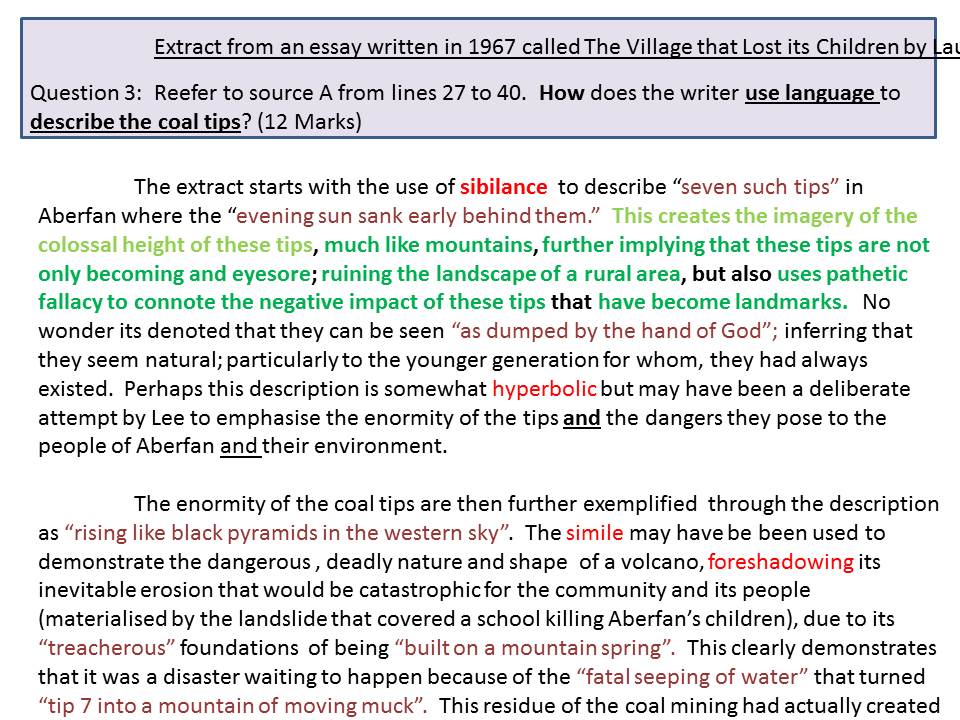
20 MARKS FOR THIS QUESTION – 4-5 PARAGRAPHS. Examine the skills in the examples.
If you’re struggling on questions 2, 3 or 4, your struggle is over! Examine my models. Follow the tips. Practice, and ace that exam.
These 3 questions test your understanding of the story told in the text; that is, how the writer uses explicit details, to infer implicit ideas. The only way you can explain the writer’s craft and give logical inference is if you read the text and ensure you know the story. Remember to use your reading time to read, highlight the main points, language and structural techniques noticed, as well as summarise (in a word or short phrase in the margin) what each paragraph is about. This is time wisely spent.
Question 5 of paper 1 – WRITING TO DESCRIBE. This is the task that you should really capitalise on, to achieve or exceed your target grade on this paper. We can all write a story. We can all use a range of descriptive techniques.
Don’t tell. Show through descriptive detail. The simplest way to do this is to remember to start your sentences with verbs, adverbs or imagery, and ensure every single sentence uses two or more descriptive techniques. Examine my tips and model. You can get 26 and above of the 40 available marks for this question easily. Manage your time to ensure you write a fully developed description or story.
There is no such thing as LUCK in exams. Success depends on how much you revise and practice.
First step is to make sure you have read, highlighted and annotated the two texts. You now know both stories – their key points and ideas. Does your reading prep look like mine below? It should!
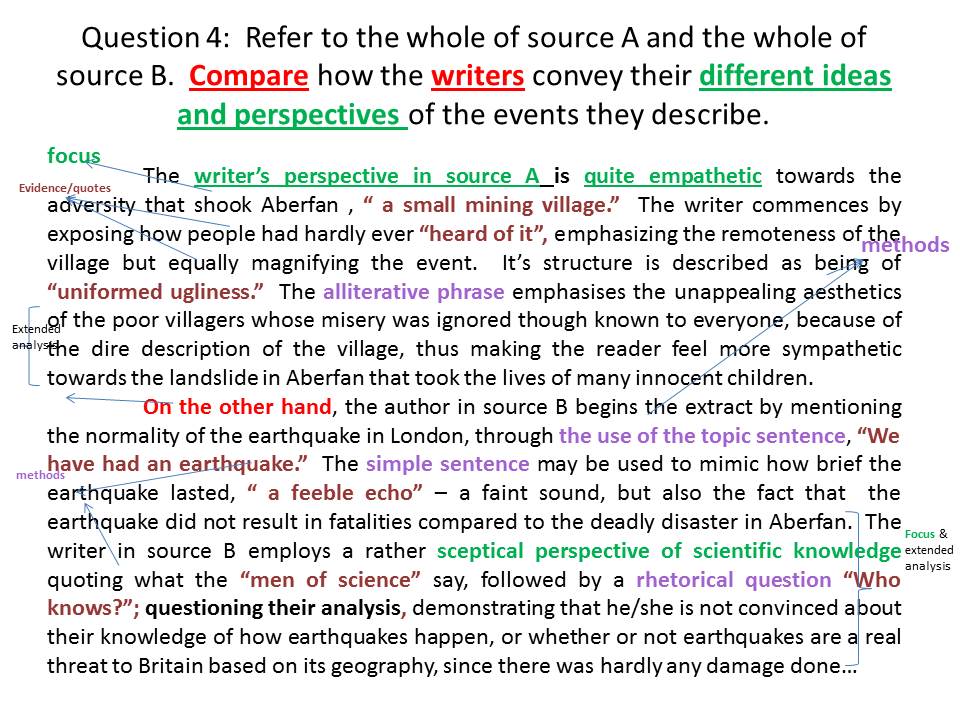
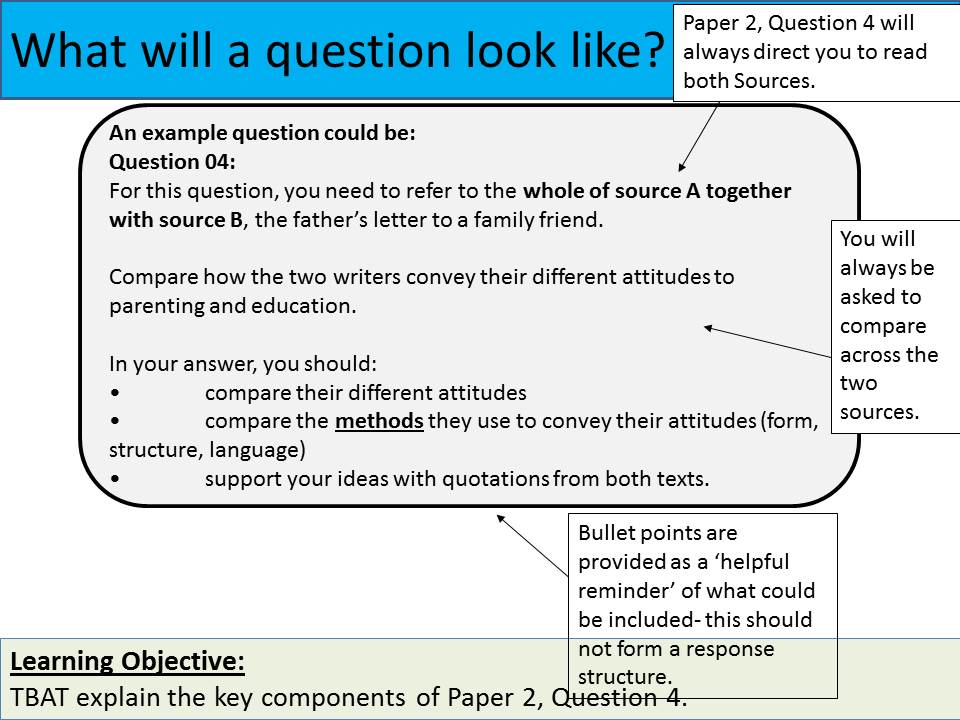
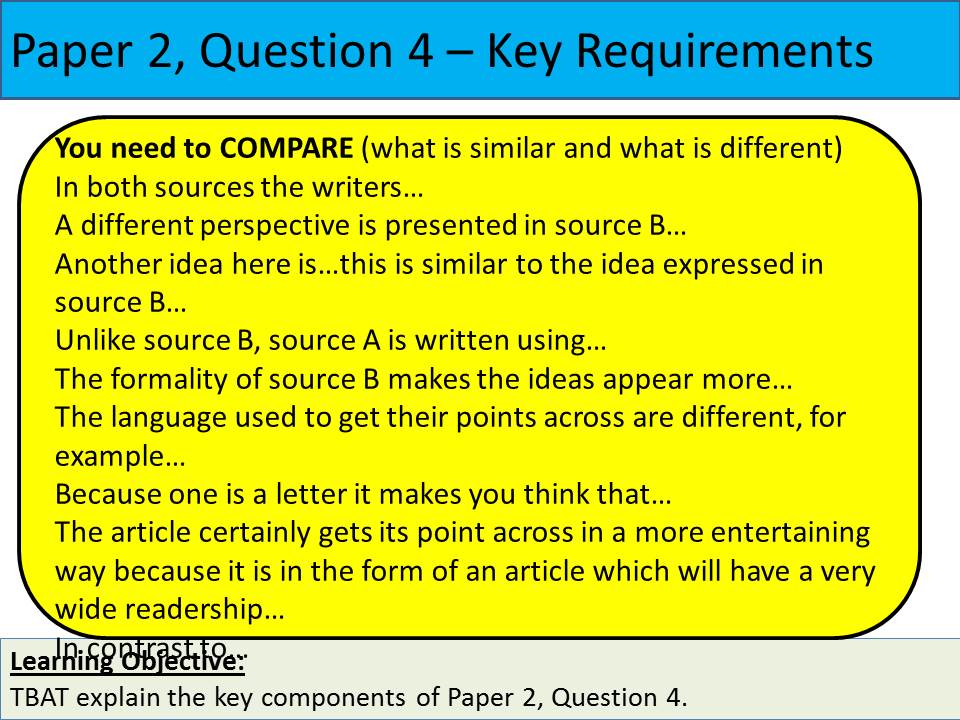
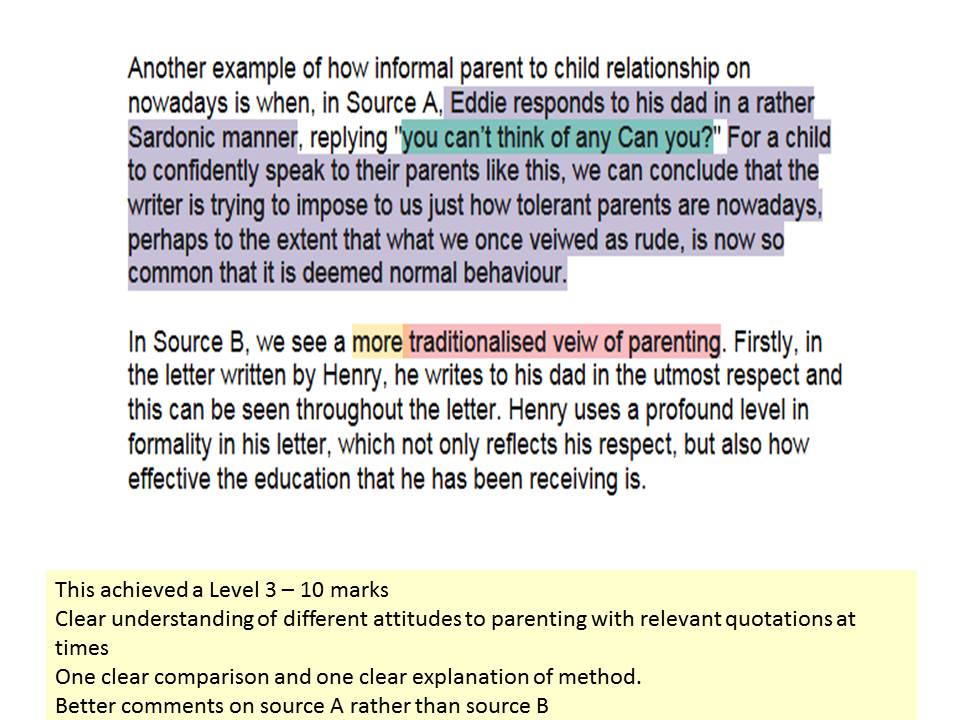
Read, highlight key points, summarise each paragraph in the margins, and annotate language techniques.Question 4 is an amalgamation of questions 1 to 3; the facts, comparing the key points of both texts exploring the similarities and differences between the writers’ viewpoints (their perspectives), as well as their form, language and structural techniques used to express their viewpoints..3 more paragraphs of that size would be sufficient, covering the beginning, middle and end of both texts, to give a holistic view of the writers’ perspectives. REMEMBER to include exploration of methods [AO2 – language, structure and form] used for effect.
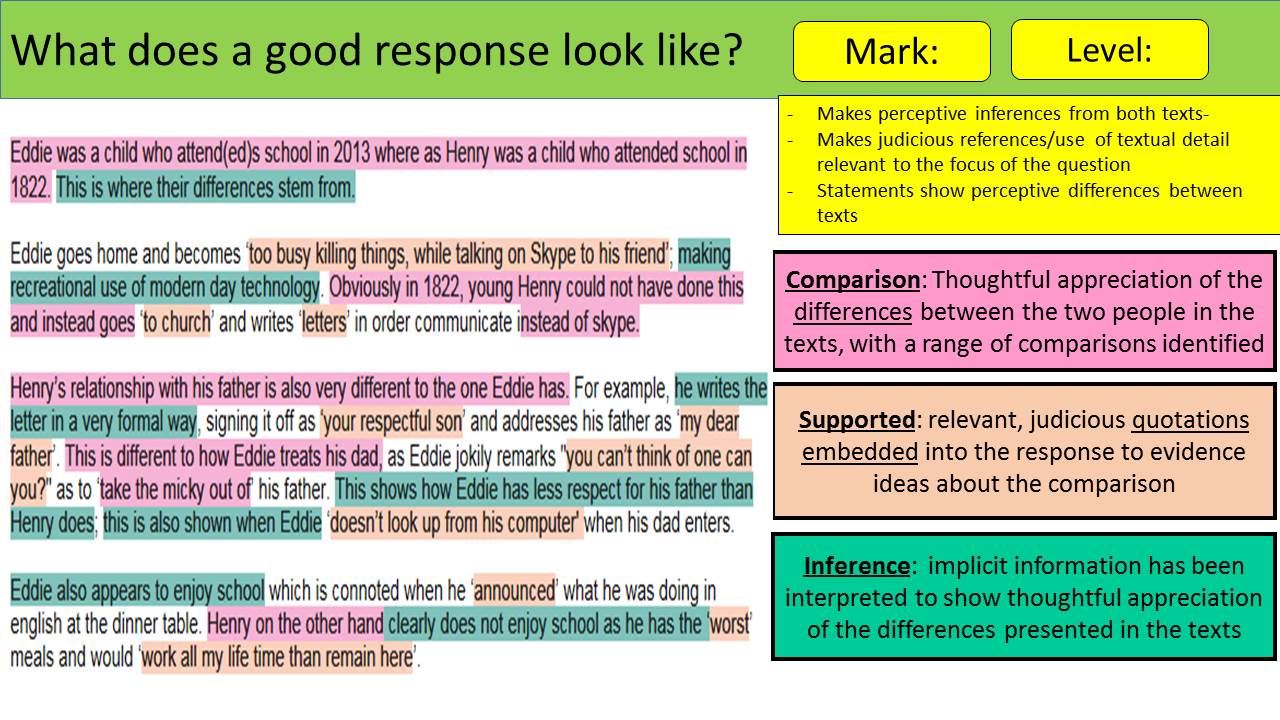
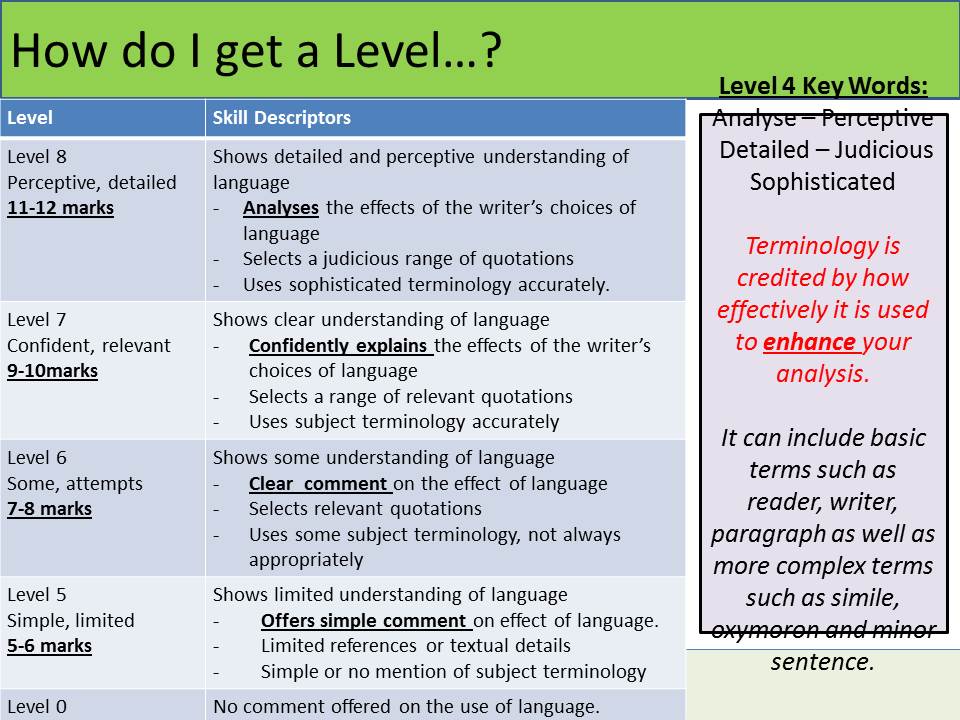
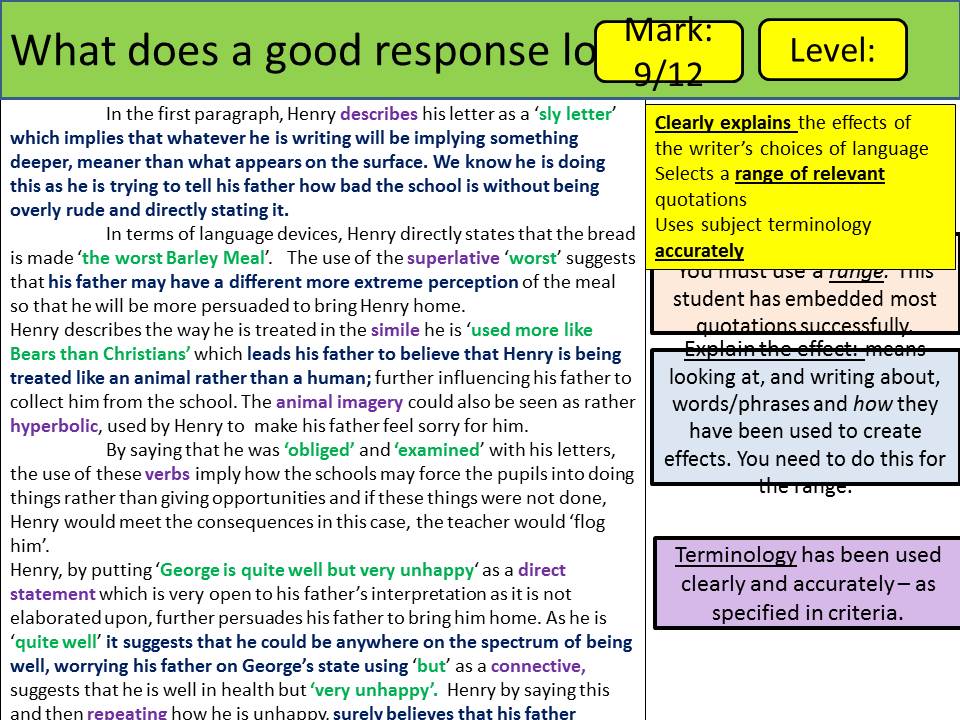
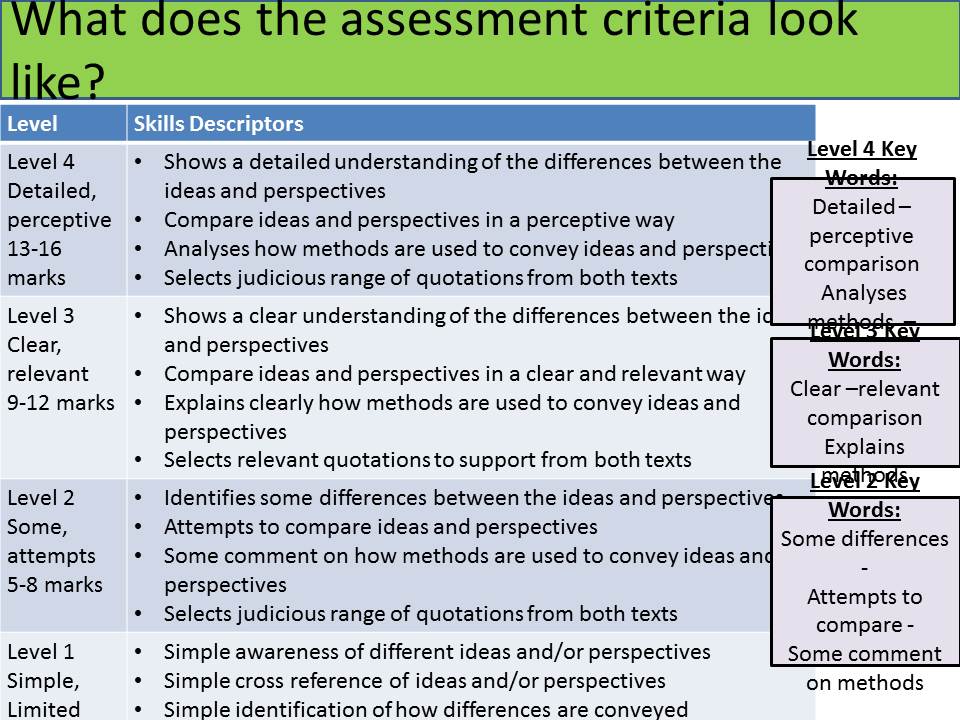
The sample answer above demonstrates the skills of a level 4 writer from the get-go. a final grade of 13 or 16 then depends on the consistency throughout the full response. Examine the colour-coding to see how it meets the Level 4 Key Words descriptors.
Be resourceful! Do not wait on your teacher. Stay ahead. Find two sources on the AQA website or online. Many schools have published booklets with sample questions and sources. Practice.
Hi Guys. 2020 so far has definitely been a difficult year for us all. Some of us may have lost loved ones or suffered ill health. This is one of the many trials in life, but as difficult as it is, life goes on. Think of the positives. We are breathing. We have overcome. We will continue to overcome. We never ever give up.
For those of you who did not get the chance to sit your exams this year, and are not satisfied with the grades you’ve been given, you will have the opportunity to sit them next year if you wish. We all need to start thinking about our next steps. If it’s GCSEs, revision and practice starts now. If it’s A level, pre-reading starts now.
Use the resources to guide you, and you can always send me a message and I will respond.
A wealth of resources for you to review, recall and practice for your End of Year Assessment. Remember! You MUST pass these exams to progress to A2. You CANNOT ‘wing it’. Complete the wider reading. Know the texts. Know key quotes.
Peruse the wealth of resources that will improve your knowledge of the text and expose you to wider reading, related context and activities to enrich your study of the text.
Use my reading and prep guide below. Guaranteed better understanding of what each is about, so that you can respond to the questions effectively. PROVEN to improve results!
KEY POINTS means: who, what, when, where, why – key descriptions of settings, characters, events etc. This makes the information accessible for quotes and you now know the plot and context.
Look closely at each question, models and some marked responses. There is no reason not to achieve or exceed your target grade on this paper. Absolutely none!
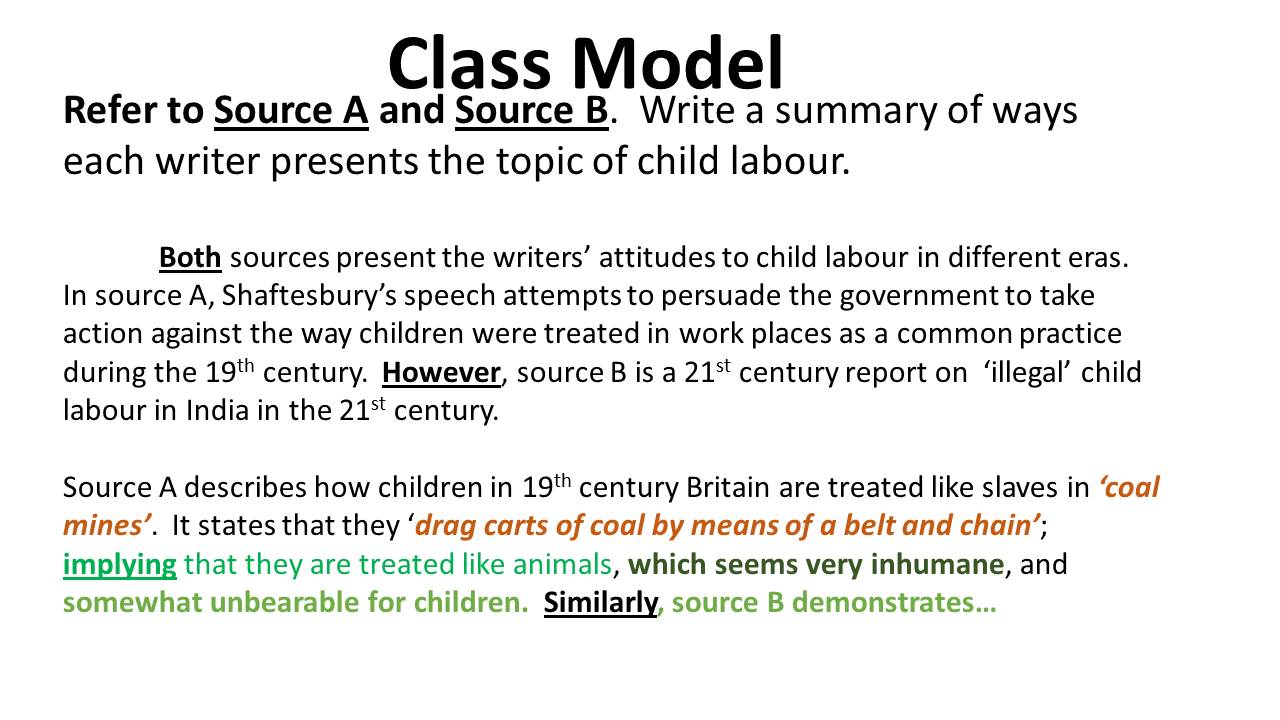
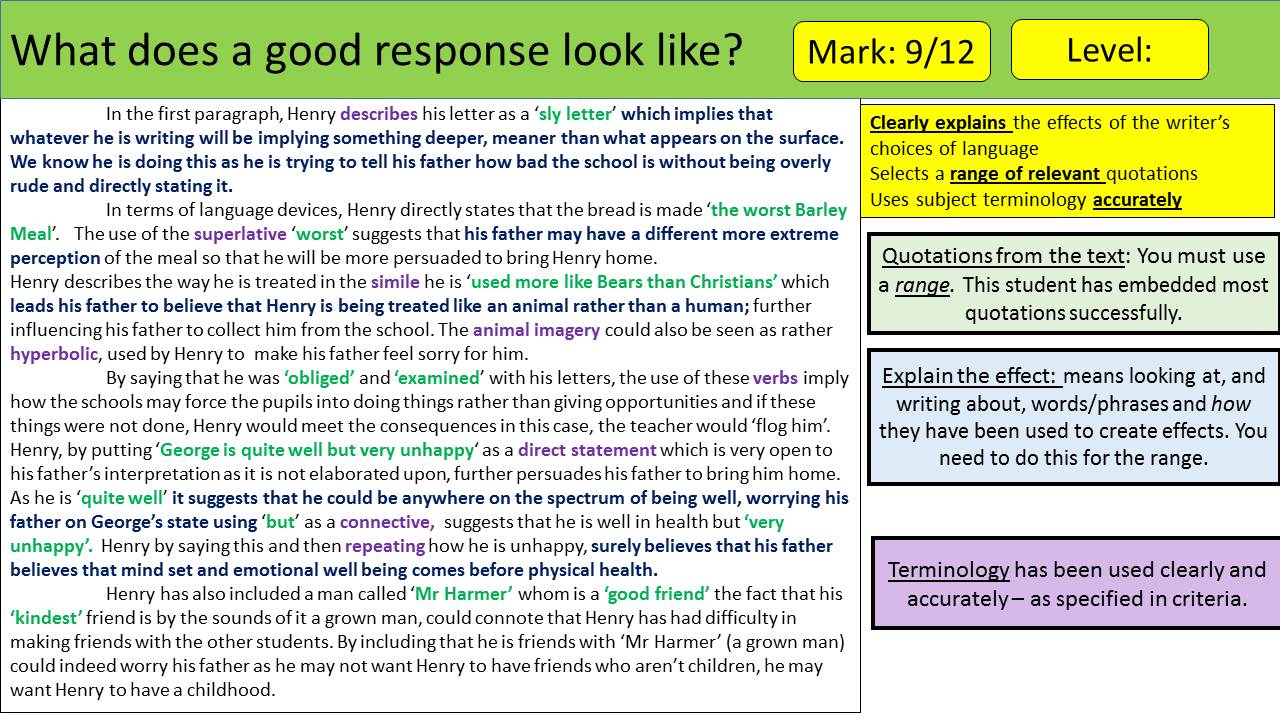
To be successful in this 8 mark response, you simply need to give extended analysis of quotes and techniques used. You are not just spotting techniques. You are explaining the effects created by their use. Examine the example below.
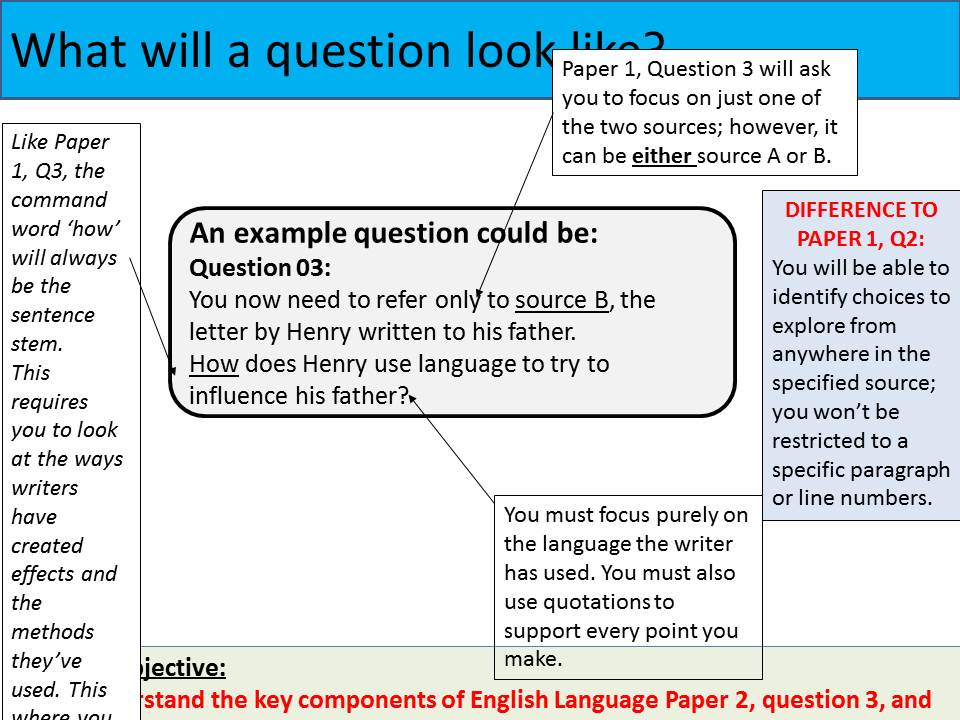
You CANdo well on this question. Remember to include methods (Language and structural techniques: similes, metaphors adjectives, contrast, sentence type 1st or 3rd person narrative etc…) Aim to use minimum 10 quotes giving extended analysis of each.
Everybody can write a story. Everybody can describe. You are simply showing your skills of using a wide range of descriptive techniques, vocabulary choices, paragraphing, sentence types and punctuation to create an engaging narrative or description. This question is your chance to maximise your marks.
Look closely at each question, models and some marked responses. There is no reason not to achieve or exceed your target grade on this paper. Absolutely none!
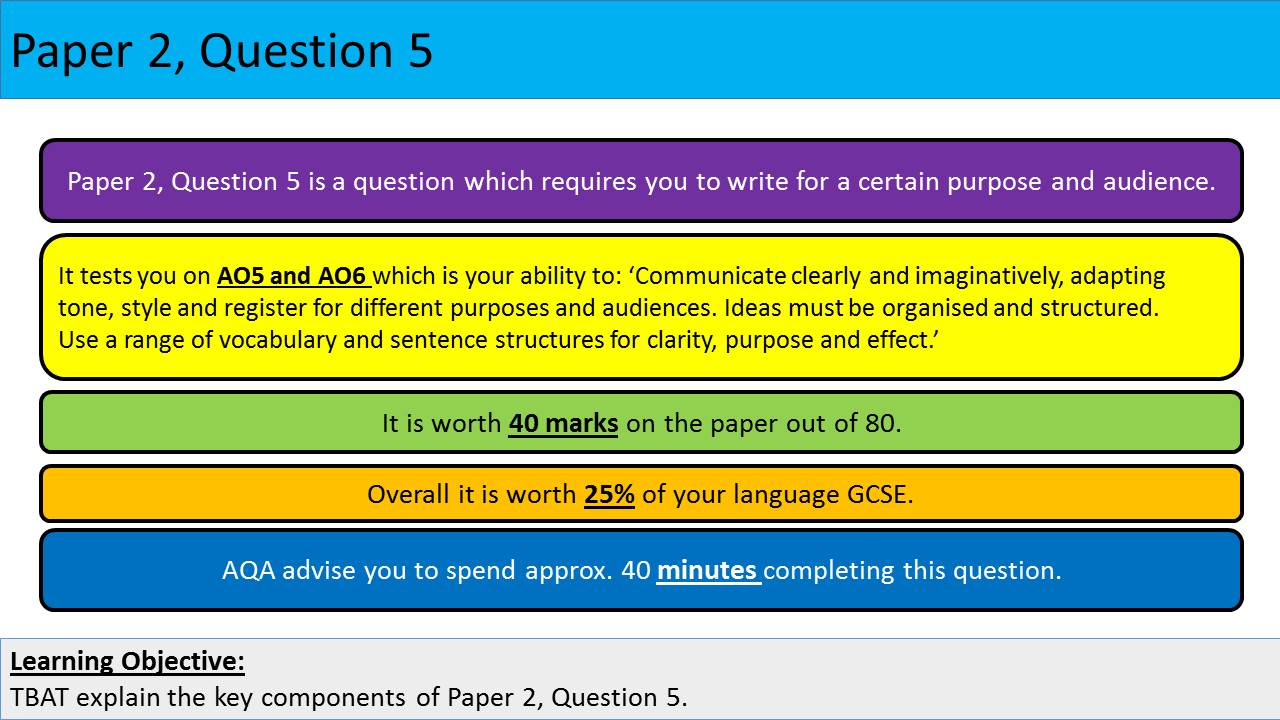
Remind yourself of the structure of each question. Pretty much the same skills as paper 1, except QUESTION 5 is now a persuasivewriting rather than descriptive.
Remember to prepare and plan by reading both texts fully. Highlight the key points as you read, then summarise in a phrase ( in the margin of each paragraph) what that paragraph is about. This ensures you FULLY UNDERSTAND the story being told in each: who, what, where, when, why – descriptions of events, characters, setting etc. Only then can you effectively respond to questions 2,3 and 4.
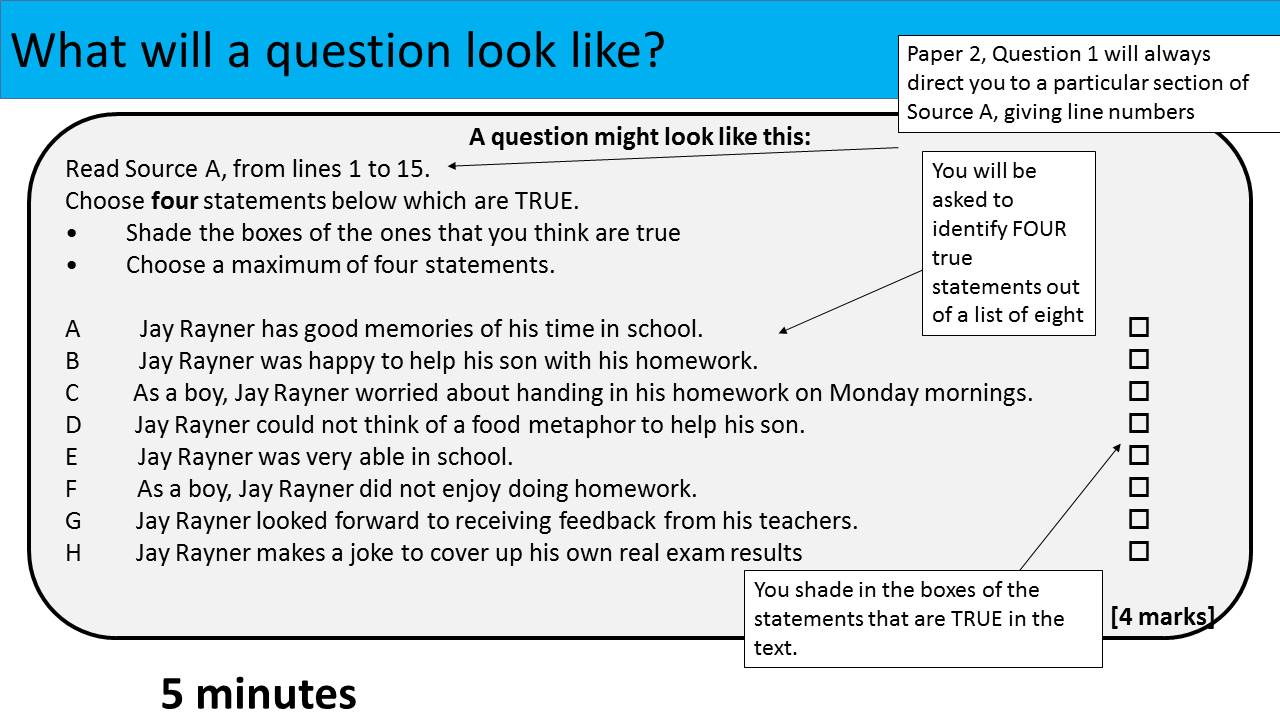
1 hour 45 mins. 50% Paper 2: Writer’s viewpoints and perspectives. 1 hour 45 mins. 50% Reading – 40 marks 15 mins read and plan. Find four… 4 marks 5 mins. Language 8 marks 10 mins. Structure 8 marks 10 mins. Evaluate 20 marks 20 mins. Writing – 40 marks. Describe or narrate : choice from two questions 24 content 45 mins 16 accuracy. Reading – 40 marks 15 mins read and plan. Select four… 4 marks 5 mins. Comprehension 8 marks 8 mins. Language 12 marks 12 mins. Compare 16 marks 20 mins. Writing – 40 marks. Write in a viewpoint. 24 content 45 mins 16 accuracy.
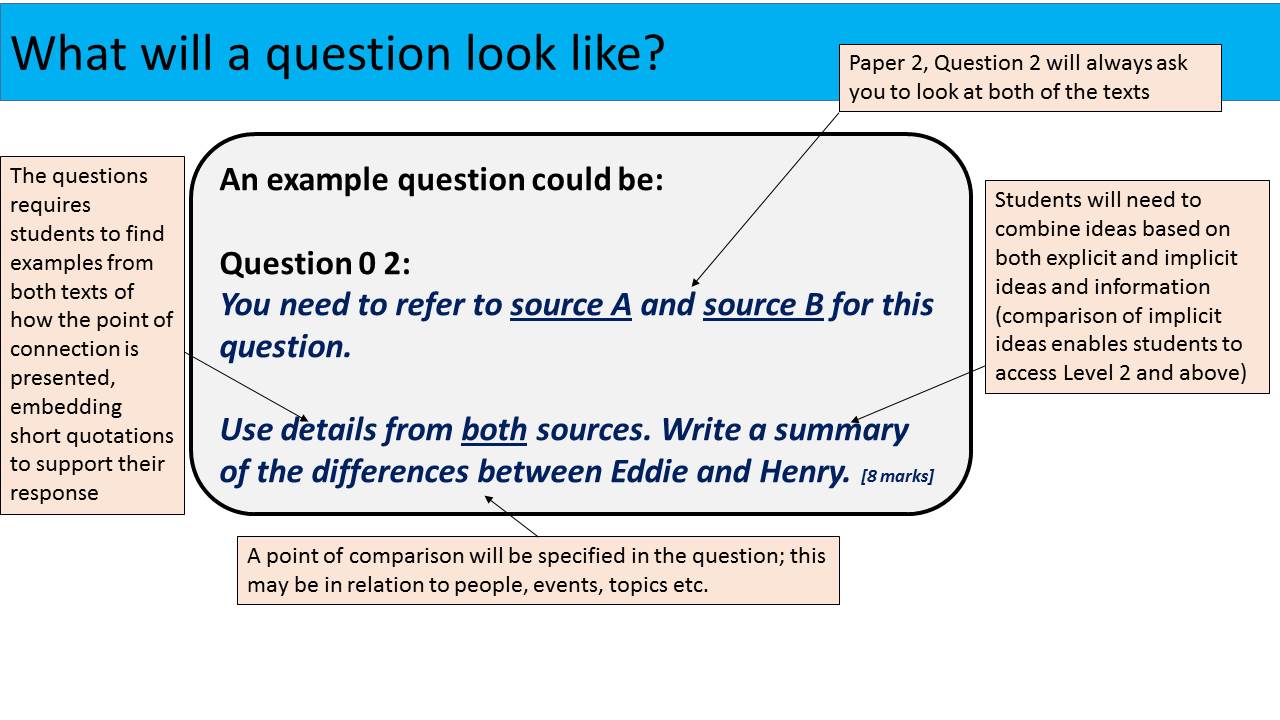
Paper 1 and paper 2 are similar but you MUST note the differences. Question 2 is a summary question. Traditionally, we don’t normally infer in summaries, but you do for this question. The difference between this and paper 1 question 2 is that your inference (This suggests… It also…) )shows your understandingof the key ideas of the plot – the story being told, NOT LANGUAGE. You MUST give more than a basic explanation of quotes to get a mark in the CLEAR band and above, which is where you are aiming for.
Your explanations (extended analysis) MUST reflect the plot – the events, the characters’ actions and thoughts, the impact on the reader and the writers’ intent or purpose.
Know the context? Know the key themes? Know Priestley’s purpose or intent?
REMEMBER to lead your discussion with Priestley’s purpose, context and/or themes. This means that your analysis is driven by deeper meaning rather than plot. The plot is simply Priestley’s vehicle to highlight wider issues in society in his quest to push for change during this era of capitalism and class divisions which created a huge gulf between the rich and the poor – the working class suffering immense inequality and injustices both socially and economically. Priestley wanted to bridge that gap.
1945- Germany surrenders and WW2 ends. 60 million people were killed including Holocaust victims, soldiers and civilians. This was 2.5% of the world’s population Queen Victoria died. King Edward VII, her son, became king. The era changed from the Victorian era and became the Edwardian era. April 15th the Titanic sank. Approximately 1,500 people died Germany surrenders and WW1 ends. Approximately 8 million lost their lives. 1930s- America is bankrupted which effects the rest of the world. It was named the Great Depression. Adolf Hitler becomes the Fuhrer (dictator) of Germany King Edward VII died and his son, King George v, took the throne WW1 broke out. 1920s- A time of prosperity WW2 broke out Women were given the vote and although men were still considered the superior gender this was a monumental step for women’s rights. Spring The play is set two weeks before the Titanic sank and two years before WW1 broke out. During this period there was a very strict social hierarchy where the rich and the poor were divided. The rich generally did not care about the poor. The capitalists took charge of the country; there was no welfare system so this was a laissez-faire society. During WW1 no matter how rich or poor young men were they were forced to conscript to the armed forces and fight the Germans. What do you suppose the implication would be for the characters in the play ‘An Inspector Calls’ was published during a time when Britain was in great disorder. People had learnt to ‘pull together’ during this time they had to take care of one another and this is an important moral message in the play Priestley served during WW1 and was wounded in 1916 by mortar fire. His experiences during the war, like so many other soldiers, changed his perception of society.
Follow these basic steps below and you will be able to write about the unseen poems. Remember that the first (the 24 marker), requires you to write a full essay response.
The 8 mark comparative requires you to compare the techniques used in both poems for effect. 2 points on each poem, with extended analysis of the the effects of the techniques used, is enough.
REMEMBER!You are comparing the techniques both poem use to express the key ideas of their poem. It might no be advantageous to try to learn a new acronym ( BOOTSE – SLIMER etc) as a structure at this stage. Have confidence in what you’ve been taught, but use any ideas from the videos that you think will be of help.
Get your best grade to date in this MOCK exam. You can do it if you revise plot, characters, themes and context. Remember! The question will always give you an extract. There will always be a clear focus on either how a character, a theme or how a character and theme is presented in the extract, and in the play as a whole. Start with the extract (choosing at least 6 quotes to explode), then chose 3 other scenes in the play as a whole to discuss, that responds to the focus.
Extended analysis that explores language and dramatic techniques used, links to the focus, other key themes, context, Shakespeare’s intent and impact on the audience is where you get the marks.
TOP-UP your knowledge using the links below, the examine the exemplars in the previous post to remind yourself of how to structure a full (6 paragraphs) essay response.
Everybody can write a story. Everybody can describe. You are simply showing your skills of using a wide range of descriptive techniques, vocabulary choices, paragraphing, sentence types and punctuation to create an engaging narrative or description. This question is your chance to maximise your marks.
One of the most interesting plays by Shakespeare! Know the context and plot well and you’re halfway there.
Lead your analysis with context, themes or writer’s intent, then pull the plot in. The plot is simply the vehicle used by Shakespeare to teach the wider messages of the play.
Peruse the resources below to top-up on your knowledge of the context, plot and key themes. Your study of this text will culminate into a single essay on your GCSE Literature exam. It will always be a task based on how a character or key theme is presented. Take the initiative to examine exemplar responses to past exam questions on the AQA website. Responding to the exam task on this text is simple, if you revise and practice.
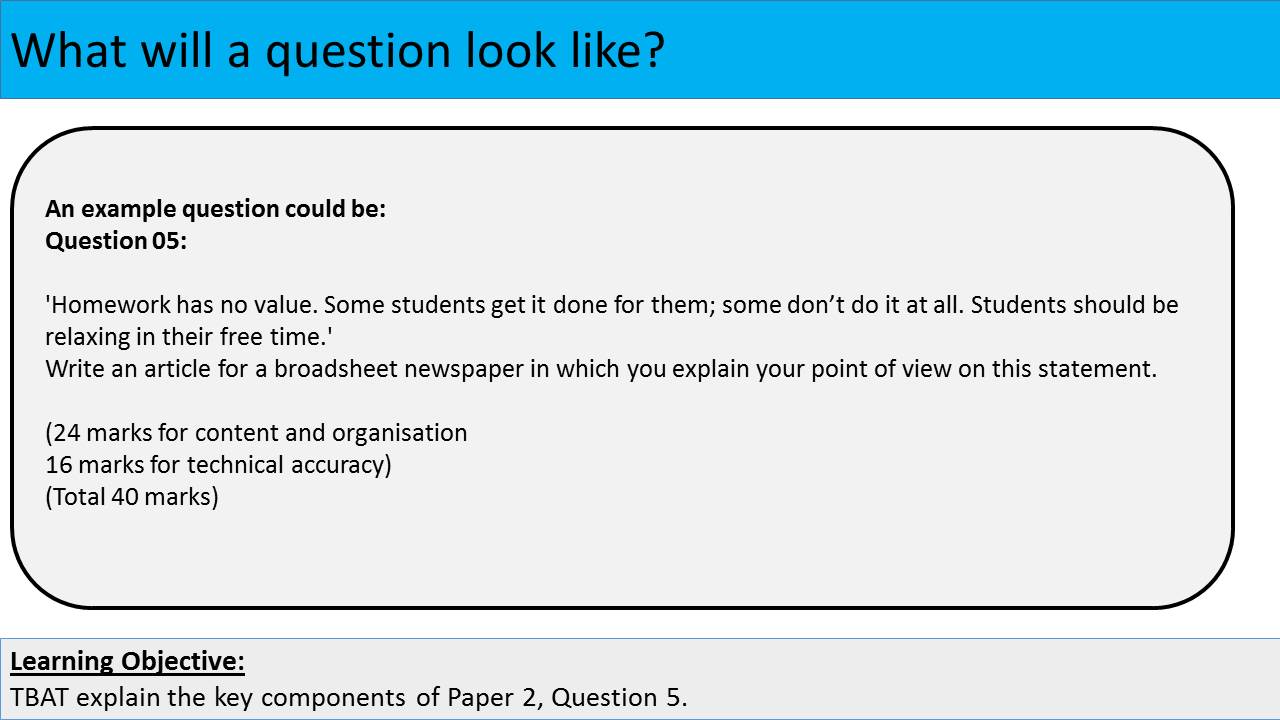
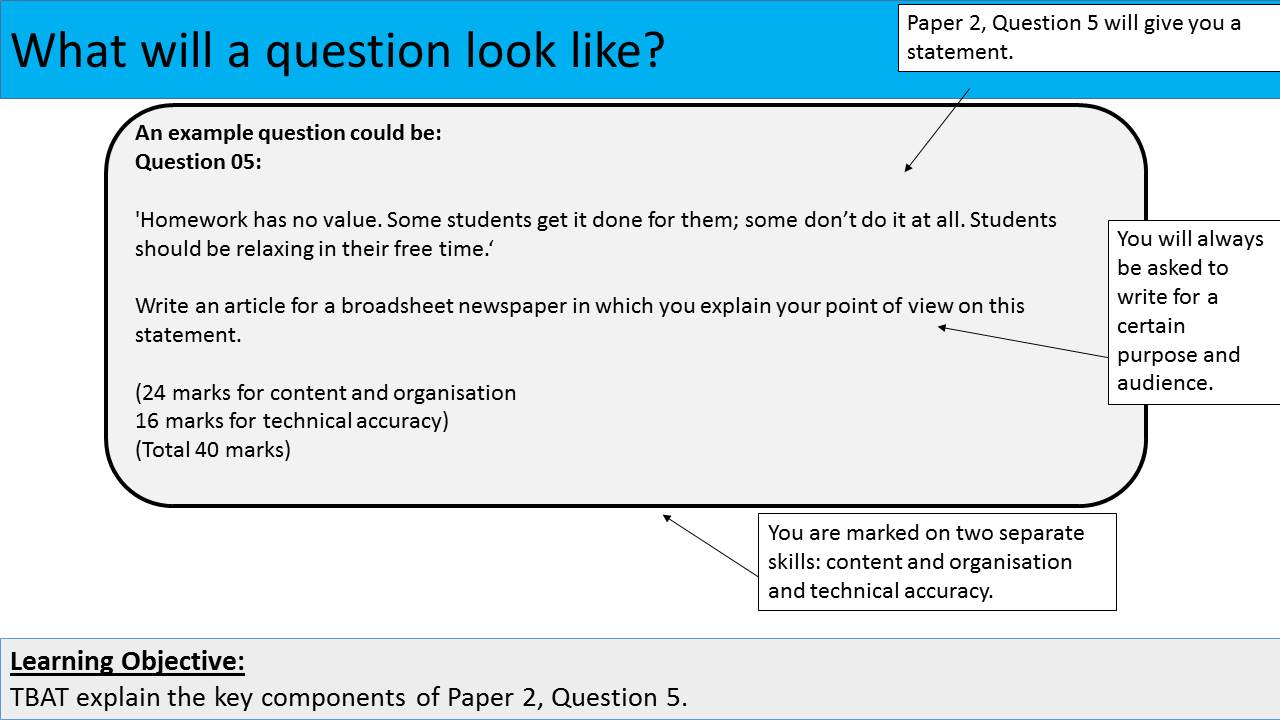
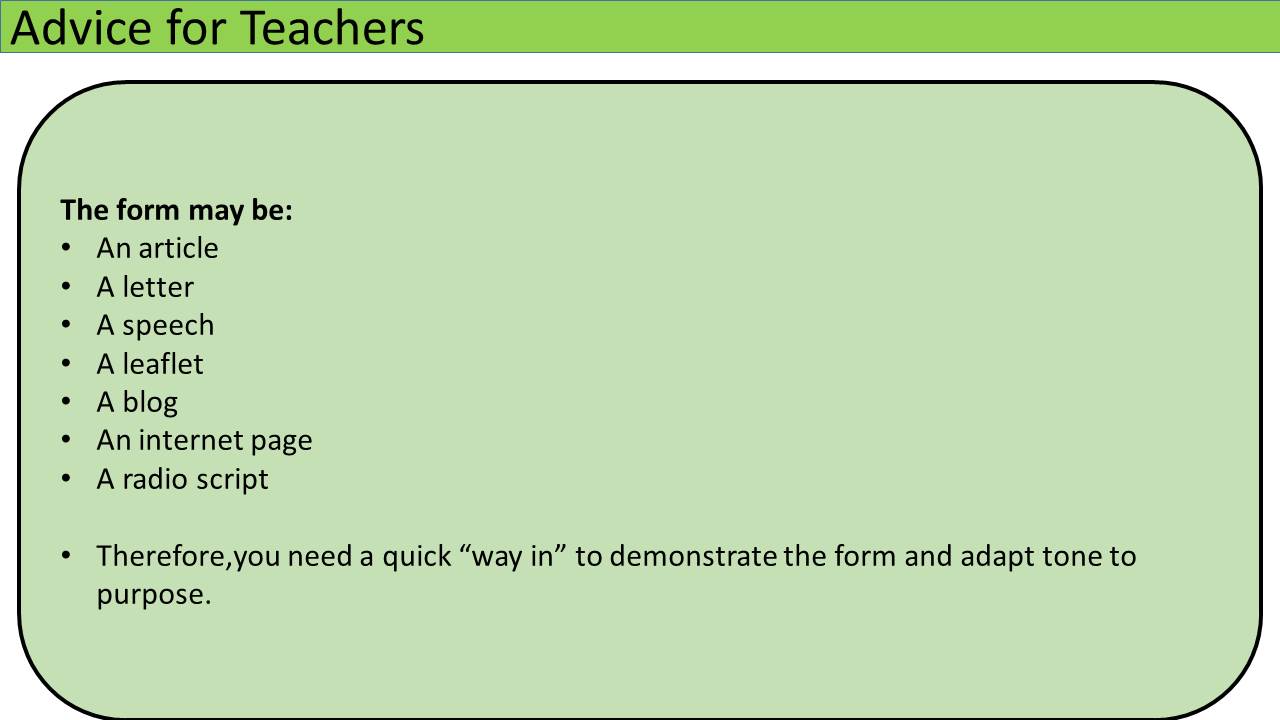
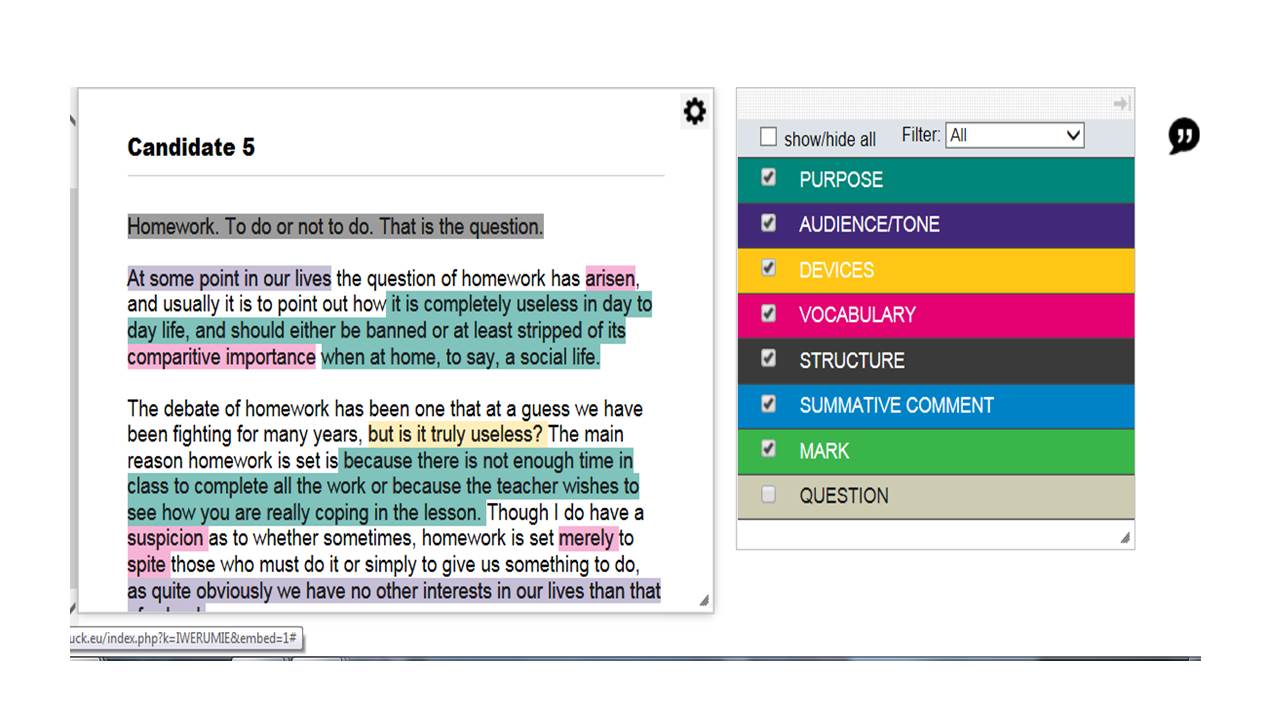
Question 5: Writing an Article. Examine the tasks and sample responses that achieved excellent marks:
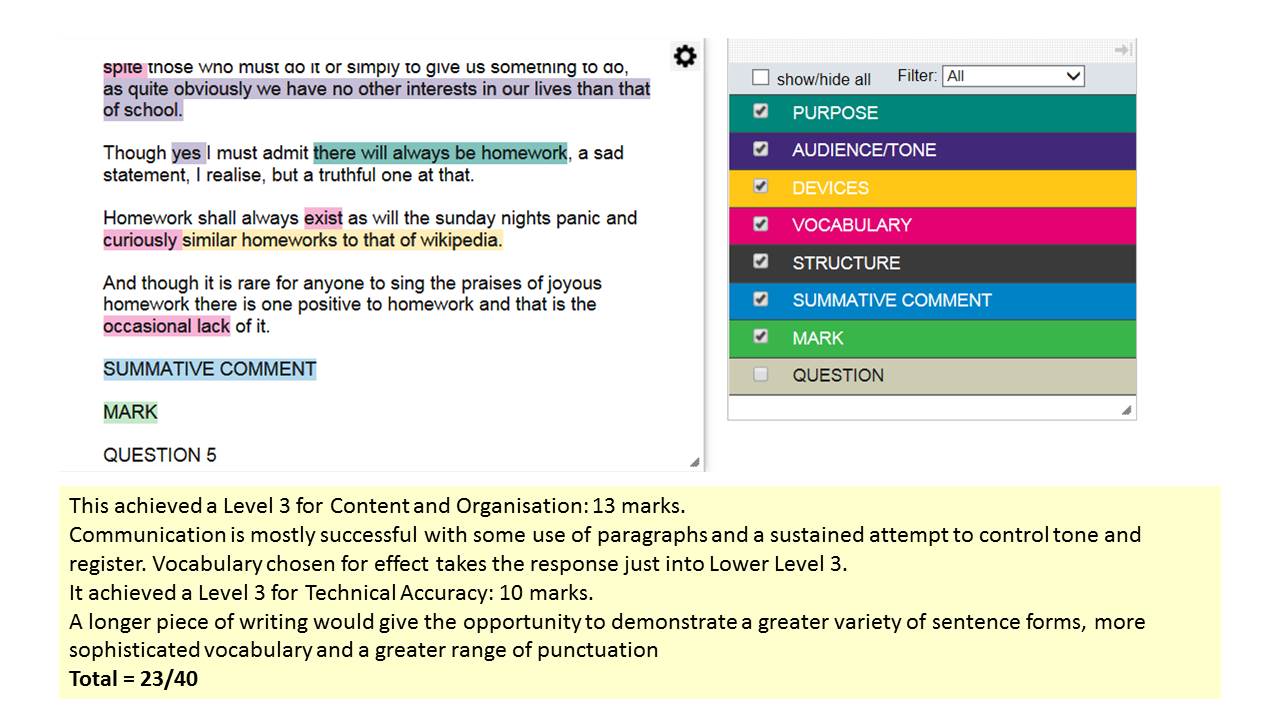
AO5 – 21 marks – Convincing argument although uneven in places – convincing and assured tone – highly engaging style – extensive vocabulary – conscious crafting of language – coherent use of paragraphs
AO6 – 15 marks – consistently secure and accurate demarcation – extensive vocabulary but lacks range for highest level of spelling – high level of technical accuracy
Question 5: Writing an Article. Examine the tasks and sample responses that achieved excellent marks:
AO5 – 21 marks – Convincing argument although uneven in places – convincing and assured tone – highly engaging style – extensive vocabulary – conscious crafting of language – coherent use of paragraphs
AO6 – 15 marks – consistently secure and accurate demarcation – extensive vocabulary but lacks range for highest level of spelling – high level of technical accuracy
How do I structure a response to the Macbeth question? Firstly, all questions on the English Literature paper require essay-style responses, regardless of the text (modern prose, poetry or drama). So just as you did in your response to An Inspector Calls, a clear structure is important in expressing your ideas clearly and logically. Follow my advice and examine the exemplars. These WILL help you to achieve or exceed your target grade.
Structure your response as a 6-paragraph essay; an introductory paragraph, followed by 4 paragraphs (the main body that responds to the focus of the question in PEA paragraphs), then a conclusion that briefly summarizes your main points in response to the essay focus.
Remember to identify and highlight the focus (what you are asked to write about) of the essay in the task. You are never expected to write everything you know about a…













 Mrs Sweeney's GCSE and A level English Success Guide